Natural questions, not only perfect prompts
Students can phrase a question in their own words and follow up when an explanation does not land. Conversation mode supports open-ended back-and-forth; Guided lesson mode asks the tutor to lead an explanation and use the board when helpful. This makes the interaction feel closer to asking for help than filling in a fixed quiz.
A concrete example: distance and displacement
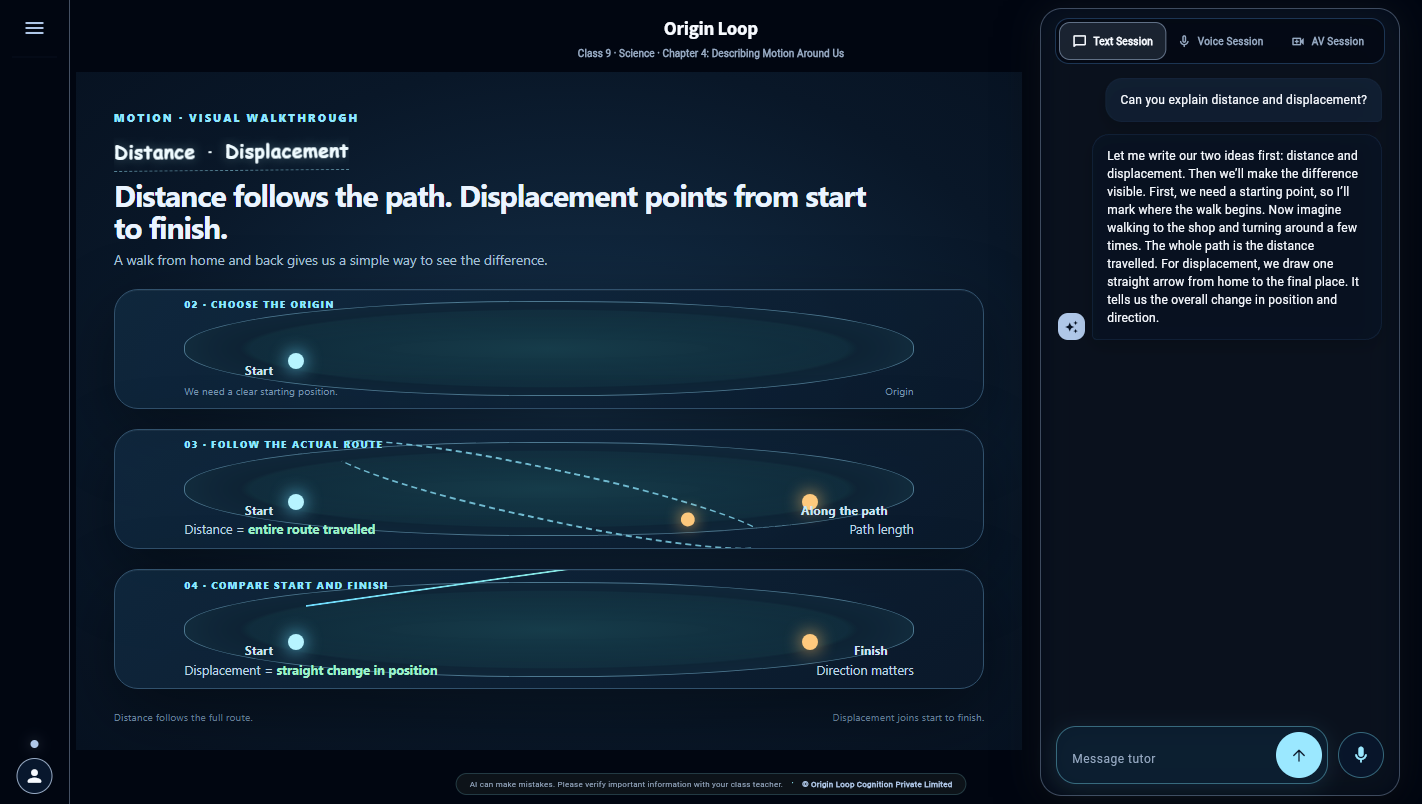
In the captured synthetic interaction, the learner asks, “Can you explain distance and displacement?” Lia distinguishes the full route travelled from the straight change between start and finish, then presents a staged visual comparison. A teacher can use the example to ask the learner to explain why returning home gives a non-zero distance but zero displacement.
Support at the learner’s pace, with limits
A student can ask for another explanation without needing to wait for a whole-class pause. That may create more opportunities for practice and let teachers reserve time for misconceptions and individual support. It is a design intent, not a measured learning gain. The only currently lesson-ready path is a limited Class 9 Science Motion demo; catalogue visibility does not mean every lesson is ready.
Keep the teacher in the loop
The assistant is an additional learning support, not a replacement for instruction or assessment. Teachers remain responsible for checking understanding, correcting errors and deciding when a learner needs direct human help.